
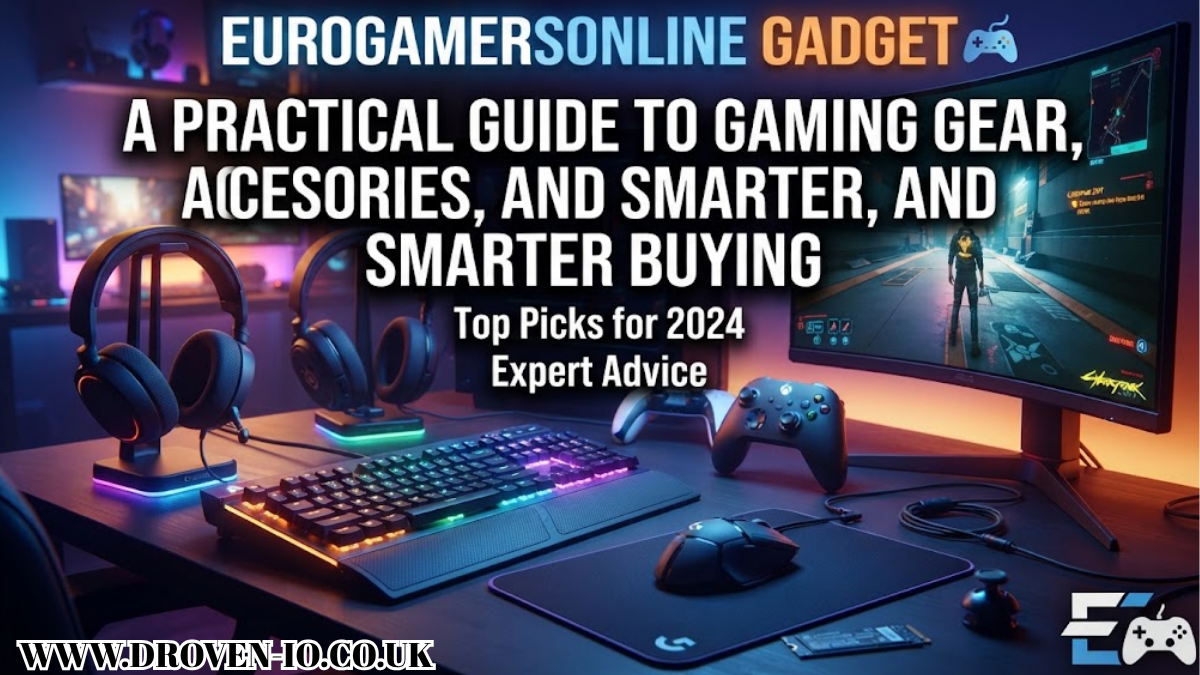
The phrase eurogamersonline gadget is increasingly associated with gaming hardware, peripherals, accessories, and buying guides aimed at players who want more from their setups. EuroGamersOnline has a dedicated gadgets section covering gaming-related hardware and technology topics, including controllers, headsets, monitors, PCs, console accessories, and other devices.
But there is a problem with the way gaming gadgets are usually discussed online: the newest product is not automatically the most useful one.
A $250 accessory sitting beside your console can look impressive and still do almost nothing for your actual gaming experience. A modest $60 headset, a better mouse, an Ethernet cable, or a properly positioned monitor can sometimes make a much bigger difference.
That is the approach worth taking with gaming technology: buy based on the problem you are trying to solve, not the marketing attached to the device.
What does EuroGamersOnline cover in its gadget content?
EuroGamersOnline’s gadget coverage is broader than a simple list of products for sale. Its current gadgets archive includes buying-oriented material, gaming hardware discussions, accessories, emerging technology, and practical setup ideas. The site’s recent gadget content discusses everything from gaming PCs and consoles to headsets, keyboards, mice, virtual-reality equipment, and networking hardware.
That makes the topic useful even if you’re not shopping for one particular product.
A player building a PC gaming setup has different priorities from someone playing Fortnite on a PS5 in a small apartment. A college student who moves between dorms needs portability and simple connections. A competitive FPS player may care deeply about latency and mouse control, while someone spending 30 hours a week in RPGs might get more value from a comfortable chair and high-quality audio.
The best accessory is therefore the one that removes an actual limitation.
Which gaming gadgets are worth buying first?
For most players, the smartest upgrades fall into four areas: audio, input devices, display, and connectivity.
Audio is usually the easiest upgrade to notice. A quality headset can improve positional awareness, voice communication, and immersion without requiring you to replace your console or PC. Compatibility matters, though. PlayStation’s current support documentation, for example, lists specific wireless headsets and explains how USB adapters and supported third-party devices connect to PS5.
For a competitive player, a reliable wireless headset with low-latency transmission can make sense. For someone who mostly plays single-player games, spending less on microphone-focused features and more on comfort and sound quality is often the better move.
Then there are input devices. PC gamers should pay attention to mouse shape, weight, sensor performance, switch feel, and keyboard layout rather than chasing the highest possible DPI number. A mouse set to an extremely high sensitivity does not magically make you more accurate. Your grip and control matter more.
Console players should think similarly about controllers. Back paddles, interchangeable sticks, adjustable triggers, and improved ergonomics can be genuinely helpful, but only if your games benefit from them.
The display comes next. If your current monitor has poor motion handling or a low refresh rate, upgrading it can be far more noticeable than buying decorative RGB accessories. Competitive PC players often prioritize higher refresh rates, while console players may care more about resolution, HDR support, HDMI features, and whether the screen works properly with their console.
Finally, there is connectivity.
A surprisingly large number of “gaming performance” problems are actually network problems. If your online matches constantly spike from a normal ping into unstable territory, buying a more expensive controller will not fix it.
Why latency matters more than flashy specifications
Gaming gadget marketing often focuses on specifications that sound impressive but have limited practical value.
Latency is different.
A delay between your input and what happens on screen can affect competitive games, especially shooters, fighting games, racing titles, and rhythm games. The total experience depends on several links in the chain: controller or mouse response, display processing, game engine timing, and network latency in online play.
That means you should avoid judging an accessory from one number alone.
Take a headset as an example. A wireless connection marketed as “fast” is useful only if the real-world connection remains stable and the audio stays synchronized. Sony describes its PlayStation Link technology as designed for a stable, ultra-low-latency wireless audio connection, illustrating why the connection method itself can matter more than simply seeing the word “wireless” on a box.
The same principle applies to controllers, mice, monitors, and networking equipment.
What should PC gamers prioritize?
PC users generally have more choices, which can make buying decisions harder rather than easier.
If you’re upgrading a gaming PC setup on a budget of around $300, I would not automatically spend all of it on one accessory. A more balanced approach might be a 100–150 monitor upgrade, a 50–80 mouse, and the remainder toward a good keyboard or headset, depending on what your current equipment lacks.
Your existing hardware should decide the order.
For example, suppose you already have a strong graphics card but use a basic 60Hz office monitor. Upgrading the graphics card again makes little sense. The monitor may be the bottleneck in the experience you’re actually seeing.
Likewise, a player with a premium 240Hz display probably does not need to spend hundreds of dollars chasing another marginal improvement in monitor specifications. At that point, ergonomics, audio, mouse control, or desk layout may deliver more practical value.
USB connectivity also deserves attention. A crowded setup with a webcam, microphone, headset adapter, keyboard, mouse, storage device, and controller can quickly consume ports. Before buying a gadget, check whether it requires USB-A, USB-C, HDMI, a wireless dongle, or a dedicated power connection.
That five-minute compatibility check can save you a frustrating return.
What about PS5 and console accessories?
Console gamers face a different buying problem because compatibility is more tightly controlled.
The PS5, for example, supports a range of USB accessories, including controllers, cameras, wireless headset adapters, and compatible storage devices, but individual accessories can have specific requirements. Sony’s USB compatibility guide identifies different ports and supported devices, while its headset documentation recommends checking manufacturer compatibility for third-party equipment.
This is one reason I would never buy a console accessory solely because an online listing says “works with PlayStation.”
Read the manufacturer’s compatibility information.
A headset may technically connect to a console but lose certain features. A controller designed for one generation may not work with newer games. A USB accessory might require a specific port. A wireless device may use a dedicated dongle rather than ordinary Bluetooth.
Those details matter far more than a colorful product photo.
Do gaming gadgets actually improve performance?
Some do. Many improve comfort instead.
That distinction gets lost in gaming advertising.
A better mouse can genuinely improve consistency. A high-refresh-rate monitor can make motion appear smoother. A stable network connection can reduce connection-related frustration. A better headset can help you hear environmental cues and communicate with teammates more clearly.
But a charging dock, RGB lighting strip, decorative stand, or novelty accessory may have zero effect on competitive performance.
That doesn’t make those products bad.
If a $30 lighting setup makes your gaming room more enjoyable, that’s a perfectly reasonable purchase. Just don’t confuse aesthetics with performance.
A good setup should be measured by what you actually notice during a normal gaming session.
How to choose a gaming gadget without wasting money
Start with the problem.
Are your hands uncomfortable after two hours? Look for ergonomics.
Can’t hear teammates? Upgrade your headset or microphone.
Do fast games feel blurry? Investigate the display.
Keep disconnecting from matches? Look at networking.
Running out of storage? Buy storage.
Need easier cable management? Solve the desk problem.
This sounds obvious, but it prevents one of the most common shopping mistakes: buying whatever product is currently receiving the most attention online.
Set a budget before you browse. A $75 limit forces you to identify what matters. A $500 budget can actually make shopping harder because there are dozens of ways to spend the money without improving the setup significantly.
Also check the return policy and warranty. Hardware failures happen, and an inexpensive accessory isn’t necessarily a bargain if returning it is difficult.
For American buyers, shipping costs and warranty coverage can matter just as much as the advertised price. A $59 device with free returns may be a better purchase than a $49 device from a seller that makes warranty support complicated.
How the gadget guides on EuroGamersOnline can be used effectively
The most useful way to approach the site’s gadget coverage is as a starting point for research rather than as an instruction to buy the first product mentioned.
Its gadget archive includes both dedicated hardware articles and broader technology discussions. Recent material also emphasizes areas such as consoles, PC equipment, peripherals, virtual reality, and practical gaming accessories.
Use those articles to identify product categories and features worth investigating. Then verify the final specifications directly with the manufacturer.
This two-step process matters because gaming hardware changes quickly. A recommendation that made sense six months ago may no longer be the best value after new models, firmware updates, or price reductions appear.
For example, PlayStation currently provides detailed documentation for its PULSE Elite headset and PlayStation Link adapter, including compatibility and connection procedures. That kind of primary-source information is more useful for a final purchasing decision than a vague statement that an accessory is “next generation.”
The best gadget setup depends on how you play
There is no universal gaming setup.
A competitive PC gamer might prioritize a lightweight mouse, mechanical keyboard, high-refresh-rate display, wired Ethernet, and a low-latency headset.
A PS5 owner playing story-driven games might get more enjoyment from a comfortable headset, a larger 4K display, charging accessories, and better seating.
A streamer needs a completely different package: microphone, capture hardware, lighting, camera, storage, and reliable networking.
A frequent traveler might value a compact headset, portable controller, USB-C hub, protective case, and small display far more than a full desktop setup.
The most interesting thing about gaming gadgets is therefore not the gadgets themselves. It’s how they solve very different problems for different players.
What is EuroGamersOnline gadget content about?
It primarily covers gaming hardware, peripherals, accessories, and related technology, including consoles, PCs, headsets, controllers, monitors, VR equipment, and other gaming-focused devices.
Is EuroGamersOnline useful for finding gaming accessories?
Yes, it can be useful for discovering gaming accessory categories and researching features, but final specifications and compatibility should be confirmed with the manufacturer before buying.
What gaming gadget should I buy first?
Start with the part of your setup causing the biggest problem. For many players, that means a headset, mouse, monitor, controller, or network upgrade rather than a novelty accessory.
Are wireless gaming gadgets good for competitive gaming?
Yes, provided the wireless technology delivers a stable, low-latency connection. Modern dedicated wireless systems can be designed specifically to keep audio or input responsive, but compatibility and implementation still matter.
Can PS5 use third-party gaming gadgets?
Yes, but compatibility varies by accessory. Sony states that compatible USB and analog headsets can work with PS5, while third-party products should be checked with their manufacturers for specific compatibility and features.
The smartest gaming setup is rarely the one with the most gadgets. It is the one where every piece of equipment has a clear job. Use EuroGamersOnline’s gadget coverage to discover ideas, then verify compatibility, compare real prices, and spend your money on the upgrade you’ll actually feel after the first hour of play.
You May Also Read