
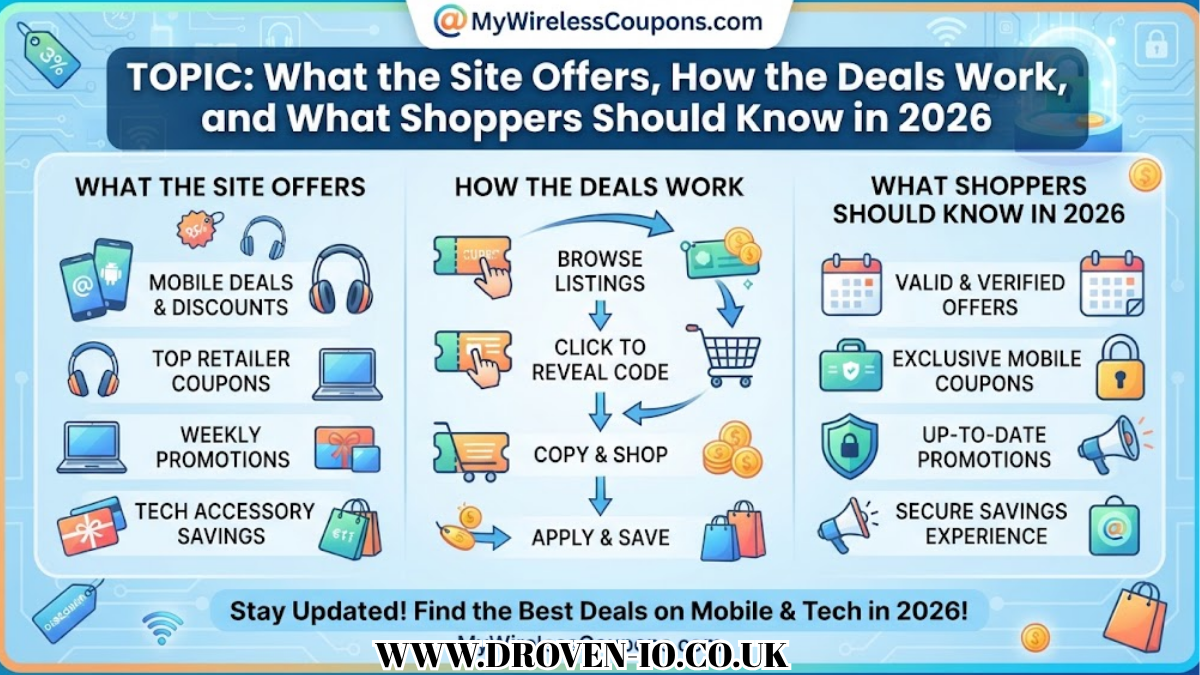
Searching for the mywirelesscoupons.com topic can be a little confusing because the site’s name sounds narrowly focused on mobile coupons, while its current publishing mix is broader. The website describes itself as a place to “Dive into Tech News, Level Up in Games, Connect on Social,” with sections covering tech tips, social media, smart-home help, and gaming. At the same time, its featured and recent articles continue to discuss wireless discounts, phone plans, accessories, activation deals, and coupon-related savings.
That distinction matters. A reader looking for a wireless coupon portal should understand that this is better viewed as a deal-and-information site around wireless technology and online savings, rather than a phone carrier itself. The site does not appear to sell cellular service directly. Instead, its content points shoppers toward promotions and explains how to evaluate offers.
What is the mywirelesscoupons.com topic really about?
At its core, the subject centers on finding ways to spend less on mobile services, devices, and related technology. Articles associated with the domain discuss phone and plan discounts, accessories, activation offers, and promotional codes. Several third-party descriptions also characterize the platform as a deal hub that gathers offers that might otherwise be scattered across individual retailer or carrier pages.
For an American shopper, that can be useful because wireless pricing is rarely as simple as the headline price suggests.
A phone plan advertised at $50 per month may involve taxes, activation costs, autopay requirements, device financing, or a multi-line condition. A “free” phone may require a qualifying trade-in and a 24- or 36-month bill-credit agreement. A discounted accessory may only qualify when purchased with a new device. Coupon sites can help surface these promotions, but the fine print still determines whether a deal is actually good.
That is where a smarter approach pays off: use deal pages to discover opportunities, then verify the underlying offer with the carrier or retailer before paying.
What kinds of wireless deals can shoppers find?
Wireless savings generally fall into a handful of practical categories.
Plan discounts are among the most valuable because a modest monthly reduction compounds over time. Saving $15 per month may not sound dramatic, but over 24 months that adds up to $360 before taxes and fees. Promotional pricing may apply to new customers, switchers, prepaid users, military families, students, or customers who bring their own compatible device.
Device promotions are another major category. Carriers regularly use trade-in credits, installment plans, and new-line incentives to reduce the apparent cost of flagship phones. These offers can be compelling, but they require careful reading. A $1,000 phone that is “free” through monthly bill credits is not the same as receiving $1,000 in cash or an instant discount.
Accessory offers can include lower prices on cases, chargers, headphones, screen protectors, and other mobile equipment. These are usually easier to evaluate because the pricing is more transparent than long-term service contracts.
Activation and switching incentives can be particularly interesting for families. A provider might offer account credits, waived fees, gift cards, or device promotions when customers transfer several lines. The catch is that eligibility can depend on the number of lines, ported numbers, payment method, and timing.
Some descriptions of the website also mention prepaid plans, BYOD promotions, and carrier-switching opportunities, which are categories worth checking when comparing the total cost rather than simply the advertised monthly rate.
How should you use coupon information without getting burned?
The biggest mistake people make with wireless promotions is treating a coupon headline as the final price.
Instead, think of the advertised offer as the beginning of your research.
Start by checking the expiration date and eligibility requirements. Then look at whether the promotion is for new customers only. Some offers require a new line, while others require you to port a number from a competing carrier. Device promotions may require a specific trade-in model, a qualifying unlimited plan, or monthly installment billing.
Next, calculate the actual cost over the period that matters to you.
Imagine a family of four sees a promotion that appears to reduce the monthly bill by $20. That sounds attractive, but if the discount disappears after three months, the total savings are only $60. On the other hand, a $10 monthly reduction that lasts two years represents $240 in savings. The percentage displayed beside the coupon is less important than the dollar amount you will really keep.
This is one reason I prefer a simple spreadsheet or calculator over judging a deal from the promotional banner alone.
Can a wireless coupon really reduce the cost of a phone plan?
Yes, but not every “coupon” works like a traditional retail promo code.
Wireless promotions often function as bill credits, account discounts, prepaid incentives, or conditional offers. A shopper may click through an offer and never type a coupon code at checkout. Instead, the provider recognizes eligibility through a referral link, account setup, qualifying plan, trade-in, or activation.
That difference is easy to overlook.
A traditional $25 coupon might immediately reduce a purchase. A carrier promotion could provide $25 in monthly bill credits spread across 24 months. If you cancel early, change plans, or fail to satisfy another condition, you may lose the remaining credits.
For that reason, the most useful deal information is not simply “save $500.” Good guidance should explain how that $500 is delivered and what you have to do to receive it.
Is MyWirelessCoupons.com a carrier, retailer, or coupon website?
It is better understood as an online publishing and deal-discovery platform than as a wireless carrier.
The current homepage contains technology, social-media, smart-home, gaming, and coupon-related content rather than a straightforward carrier storefront. Its featured articles include guides about wireless deals alongside unrelated technology topics.
That broader editorial approach can be useful for readers who like having technology advice and deal coverage in one place. However, it also means you should distinguish between information about an offer and the official terms of the offer.
When a deal involves a major U.S. carrier, the carrier’s own promotion page should be the final authority.
What should you check before using a coupon?
A quick verification process can prevent most headaches:
- Check the promotion’s end date.
- Confirm whether it applies to new customers, existing customers, or both.
- Read the requirements for trade-ins, new lines, port-ins, or minimum plans.
- Find out whether the savings are immediate or delivered as future bill credits.
- Confirm taxes, activation charges, equipment fees, and financing terms.
- Compare the final cost with at least one competing offer.
The sixth step is often skipped, and it can make the biggest difference.
Suppose Carrier A offers a $700 device credit but requires a plan that costs $15 more per month than Carrier B. Over 36 months, that extra service cost is $540. The headline device discount suddenly looks much less impressive.
Real savings come from the total cost of ownership, not the biggest number in the advertisement.
Is this website safe and trustworthy?
There is no reason to treat a domain as trustworthy simply because it has HTTPS or a polished design. At the same time, there is also not enough evidence to casually label the site a scam.
Independent automated checks have reported an SSL certificate and no obvious blacklist findings, while also flagging relatively low traffic and limited site history as reasons for caution. One older assessment gave the domain a safety score of 70/100 and noted that the domain was registered in July 2022.
The current website is active in August 2026 and publishes new articles, but its content mix has expanded well beyond pure wireless coupons.
My view is simple: use the site as a research starting point, not as a substitute for the carrier’s official checkout or terms page. Never give a coupon site your carrier account password, payment credentials, or sensitive account information just to access a promotion.
Also watch for copycat domains. Search results include similarly named addresses, including versions with a hyphen or altered spelling. Those are separate websites and should not automatically be treated as the same publisher.
Why coupon research matters more with wireless service
Wireless bills are unusually complicated compared with ordinary retail purchases.
You are not just buying a phone. You may be committing to a service plan, installment agreement, trade-in condition, insurance option, taxes, fees, and promotional credits. That creates many opportunities for a seemingly excellent deal to become mediocre over time.
For example, a $30 monthly promotional rate that later becomes $55 can look fantastic in a short advertisement. But if you only need service for six months, a prepaid plan with no long-term commitment might actually be cheaper.
Likewise, someone upgrading a phone every year should evaluate financing and trade-in structures differently from someone who keeps a device for four or five years.
The smartest strategy is to match the promotion to your actual behavior.
How I would approach the site as a shopper in 2026
I would start by identifying the purchase first: a new phone, a cheaper plan, an accessory, or a carrier switch. Then I would use the site’s articles and deal coverage to find possible promotions.
After that, I would open the original retailer or carrier offer, calculate the complete price, and check the conditions. I would not assume a code is still valid simply because an article mentions it. Coupon content can become outdated quickly, especially around major sales events, product launches, and carrier promotions.
The current site itself publishes articles specifically about finding real wireless discounts and avoiding scams, which reinforces the idea that verification should be part of the process rather than an afterthought.
FAQ
Is mywirelesscoupons.com topic about phone plans or coupons?
It covers both, with an emphasis on wireless deals, phone-related savings, accessories, and promotional offers. The current site also publishes broader technology, gaming, social-media, and smart-home content.
Does MyWirelessCoupons sell phone service?
No clear evidence suggests that it operates as a wireless carrier; it functions more like a publishing and deal-discovery site. Check the carrier’s official website before signing up for service or financing a device.
Are the wireless deals on coupon sites always current?
No, promotions can expire or change quickly. Always verify the date, eligibility rules, and final price on the retailer or carrier’s official promotion page.
How do wireless bill credit promotions work?
They usually spread the promotional value across future monthly bills instead of reducing the price instantly. Leaving the qualifying plan early can mean losing some remaining credits.
Can I trust a coupon code just because it appears online?
No, you should verify it before entering payment information. Independent checks of similarly named domains show why shoppers should pay attention to domain spelling, site age, traffic, and security signals rather than relying on appearance alone.
The mywirelesscoupons.com topic is most useful when treated as a practical starting point for wireless savings research, not a magic shortcut to the lowest bill. The best deal is the one that still looks good after you calculate the full cost, read the restrictions, and confirm the offer at its original source. In wireless shopping, five minutes spent checking the fine print can easily save far more than a flashy coupon headline.